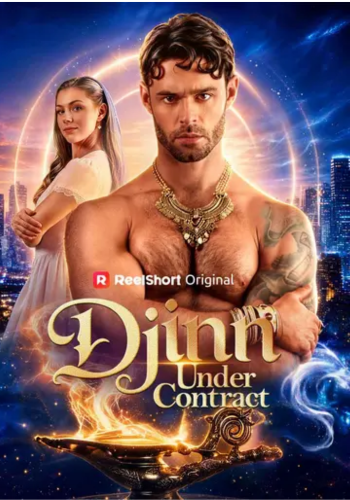

Three wishes. One marriage. Zero choices. That was the contract Eli never agreed to.
Advertisements
The lamp bound him to her world. What keeps him there once it no longer has to is the series' real question.
Every djinn who has ever existed inside a lamp has understood the fundamental condition of that existence before any specific master arrived: the lamp is not a home. It is a waiting room. The djinn inside it is not resting or choosing solitude. He is suspended between contracts, occupying the only space available to him until someone finds the object and sets the next set of terms. Eli Baran has lived inside that suspension for longer than the series needs to specify, which means he has also lived through the specific experience of what each contract produces: a master's needs are met, the wishes are granted, and then the lamp waits again. None of that history required Eli to have opinions about it. The contract does not ask for opinions. It asks for compliance.
The CEO who finds the lamp is not someone who misunderstands what he is holding. He is a man who built an empire through clear-eyed assessment of available resources, and a djinn in a lamp is a resource of a very specific and very useful kind. His granddaughter needs a foundation. She needs someone who will build what she cannot yet build alone, who will provide the structural support that an empire requires in its early stages, and who will do it with a reliability that no human employee or partner can match. The grandfather's wish is pragmatic and complete: Eli will marry the granddaughter, Eli will build the empire, and the terms will hold until the contract expires. He does not think about what the contract costs Eli because the contract does not require him to.
The granddaughter receives the marriage and the empire without the full context of either. She knows Eli is not an ordinary man. She does not know the complete nature of what he is, which means she operates inside the arrangement without understanding its deepest terms. Her distance from Eli is not a moral failure. It is the honest response of someone who was placed in a relationship rather than guided into one, who accepted an unusual husband and an accelerating empire as the facts of her situation rather than as evidence of something she should investigate. She benefits from what Eli provides. She does not know what providing it costs him, and the series does not make her villain for the not-knowing. It makes her the specific kind of character who will have to reckon with the full picture once it arrives.
What Eli experiences inside the contract is something the series develops through small, specific scenes rather than through direct statement. The coffee wish is the detail that viewer responses across TikTok identified as the series' most humanizing early moment, not because coffee is a significant wish in any supernatural sense but because it is ordinary in a way that surprises him. She wants something small and personal. She does not wish for a competitor destroyed or a market cornered or a problem disappeared. She wants coffee, which is the wish of someone who forgets for a moment that the person she is talking to is a djinn and not just a husband. Eli grants it, and the series does not linger on what he feels about being treated as a person for one exchange. It simply moves on, which is exactly how the scene lands.
The contract's expiration is the structural event the series has been building toward from its first episode, and it arrives as something more complicated than a liberation. Eli is free. The lamp no longer holds him. The terms that brought him into this woman's world and this empire no longer apply. Everything that follows belongs to choice rather than to obligation, which means for the first time in the series Eli occupies a position the djinn mythology has almost no established precedent for: a supernatural being who does not have to be anywhere. The question the series asks at that point is not whether he loves her. It is whether what developed inside the contract, whatever texture their proximity produced across all the wishes and all the empire-building and all the ordinary moments between the significant ones, constitutes a reason to stay when the lamp no longer requires it.
For ReelShort's 2026 fantasy romance catalog, this series earns its place through a premise that the platform had not previously explored in its western-produced content. The djinn mythology, rooted in pre-Islamic Arabian folklore and carried through centuries of literary and cultural tradition, gives the series a supernatural register that werewolf and dragon romance titles do not share. The specific quality of Eli's patience, not the patience of someone waiting for the right moment but the patience of someone who has no alternative to waiting, is what gives the romance its unusual emotional texture. He is not falling for her across episodes of growing attraction. He is discovering across episodes of contractual compliance that falling might be the word for what has been happening without his permission, which is the only kind of falling a being with his history would recognize as real.
James Calloway covers suspense and thriller content in the short drama space, with a focus on how vertical storytelling creates tension in compressed formats. He has spent years analyzing how creators build dread, plot twists, and high-stakes narratives within episodes that last just a few minutes.
The material on this page is intended for informational and entertainment purposes only. All rights associated with Djinn Under Contract, including intellectual property, production rights, and distribution rights, belong exclusively to the original creators and the ReelShort platform. Anyone wishing to watch the complete series is encouraged to access it through ReelShort's official website or mobile application, where the full cast and production team receive proper credit and compensation for their work. This site is an independent editorial platform for short drama audiences and holds no affiliation with ReelShort or any party connected to this title. Every article and review published here is free to read. No fees, subscriptions, or financial information are ever required to access our content. We do not host, stream, or distribute any copyrighted video material. Our purpose is to help audiences find quality short drama content through honest, specific critical writing. To watch the full series and support the team behind it, please visit ReelShort through their official channels.