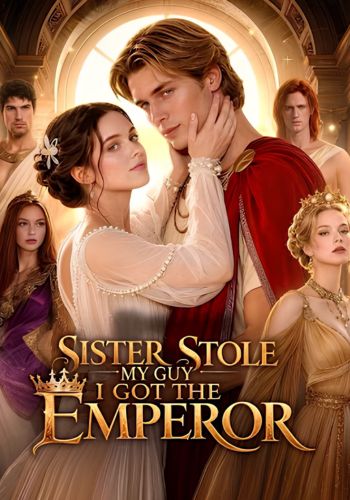

Her sister grabbed the groom, destiny gave her a crown
Advertisements
A spiteful switch at the wedding decides which daughter ends up ruling Rome
Nobody in Julia's family bets on her. In a home where a good marriage is the only ladder a woman can climb, she is cast as the second-choice daughter, the one whose prospects are expendable the moment her sibling covets something finer. The opening episodes settle the viewer into that lopsided arrangement, painting a Roman society where a wedding functions as a business deal deciding whose family ascends and whose slips down the order. The very traits that make Julia admirable, her gentleness and her sharp mind, are read by her relatives as flaws to exploit.
Everything tips at the wedding itself. Consumed by envy, Julia's sister rigs a last-minute switch, seizing the man Julia was promised to and pushing Julia toward what the whole room assumes will be a degrading second prize. The maneuver is built to disgrace her in front of everyone while lifting the sister who pulled the strings. As it happens, it reads like a bitter loss.
The irony is that the schemer bet against the wrong outcome. The husband Julia is left holding is far from a downgrade. He is Augustus, the emperor, carrying himself in a manner that conceals just how much authority is seated across from her.
The story runs on the fortune reversal folded inside that seeming shame. The fate everyone reads as catastrophic turns out to be the luckiest turn Julia could have tripped into, and the drama draws real pleasure from the distance between how the swap looks and what it truly hands her. The scorn of her relatives sours into something nearer to dread as the true weight of their blunder dawns on them piece by piece.
Most of the show's attention pours into the bond forming between Julia and Augustus. This is not a tale absorbed in military maneuvering or the gears of imperial rule. Its gaze stays fixed on the intimate, following how a walled-off emperor and a woman everyone dismissed build something honest together. The pair's chemistry does the heavy lifting, and the script reaches for warmth and comedy rather than casting the romance as a cold arrangement. Julia's transformation, from a daughter brushed aside into a woman who draws deference at the summit of Roman life, supplies the arc's emotional core.
What lifts this title above its genre neighbors is where it plants itself. While most short-form period romance falls back on interchangeable palace scenery, the Roman Empire frame lends the production a look all its own and a defined class ladder for the plot to work against. The mistaken-identity device compounds the payoff, since Julia's family passes the story slowly registering, one realization at a time, exactly whom they steered her toward. It plays as destiny-powered revenge, one where Julia need never scheme, because her rise is the sentence her tormentors serve.
Being a DramaWave production shot in vertical short form, the series is engineered for forward drive. The thirty-six-episode build strips out the padding that swells lengthier historical epics, holding the tempo tight and the emotional dividends coming often. Audiences drawn to this format for the quick gratification of a wronged heroine outclassing those who wronged her will find the beat here tuned precisely for that, each brief installment closing on a snag that tugs toward the next. Those craving thick political scheming should note the emphasis lands on romance and personal comeuppance, not the business of running an empire.
Rachel Monroe is a drama critic with deep expertise in Korean and Chinese productions. She brings a screenwriter's eye to her analysis, breaking down story structure, dialogue, and the emotional beats that make K-Drama and C-Drama so compelling. Her work helps Western audiences navigate and appreciate Asian storytelling traditions.
The purpose behind this article is limited to information and entertainment. All legal rights tied to Sister Stole My Guy, I Got the Emperor, its copyrights, trademarks, and distribution licensing included, rest wholly with the original creators, the production company, and the DramaWave platform. Anyone wishing to watch the full series should turn directly to DramaWave's official app or website, the only legitimate route by which the actors, writers, and crew earn the recognition and compensation their work merits. Our role here reaches no further than providing review and recommendation for audiences who keep up with drama. Every piece we post is free to read, without exception. We impose no fees, ask for no credit card information, and shut none of our writing behind a paywall. Nothing is hosted, streamed, or redistributed by us. Our aim is nothing more than pointing drama fans toward series worth their time through honest, considered commentary. To watch Sister Stole My Guy, I Got the Emperor from beginning to end, and to stand behind the people who made it, please visit DramaWave's official website or application.